


SEMANTIC
CONTROL LAYER
It reads each prompt to understand the meaning behind it and situates it in your business context to identify what's sensitive and what isn't.
Introducing Mavs AI Business Sensitive Data Detection.Read The Announcement →
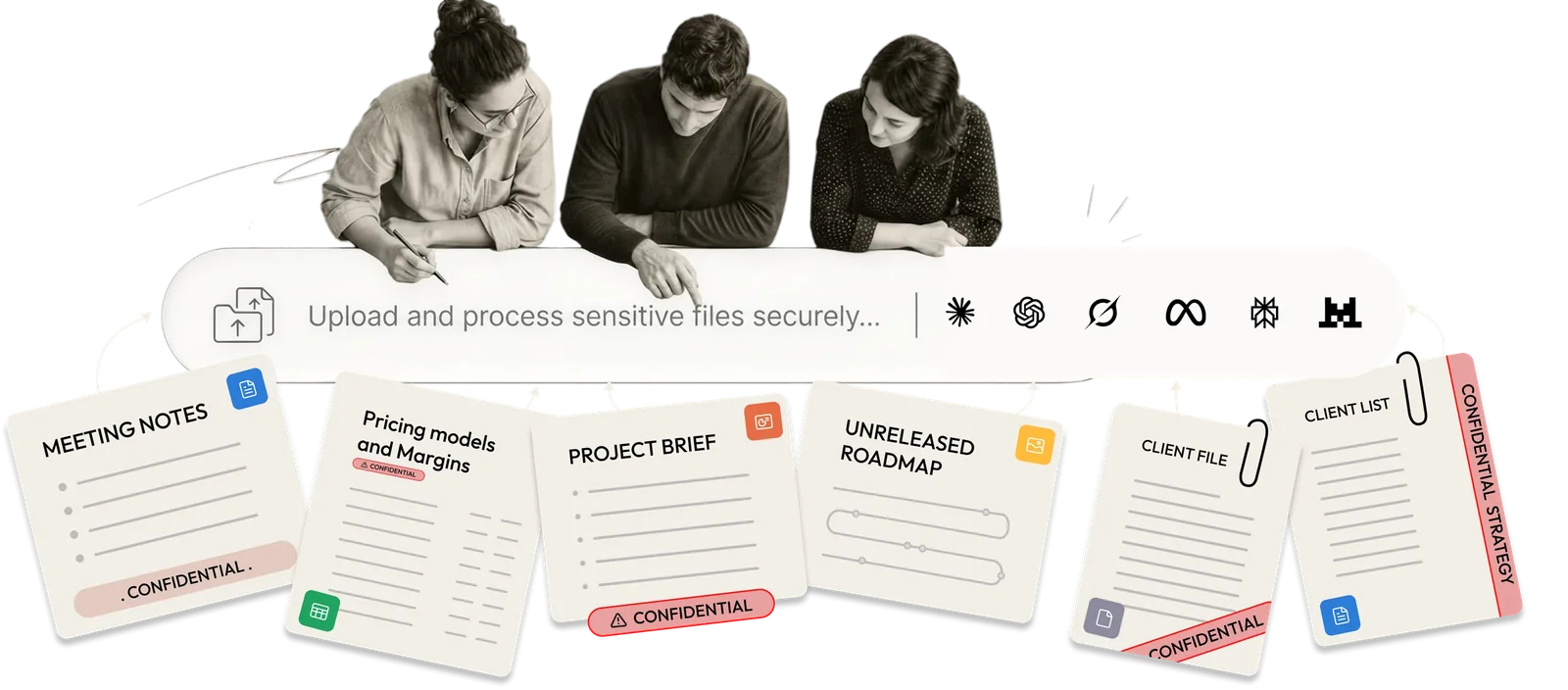
A semantic security layer for business-sensitive data that identifies sensitive data according to business context, not preset patterns.

Bear the cost of tuning and maintenance, and give up frontier models.
Slow everyone down, and still risk business knowledge flowing into third-party LLMs.
This data is not limited to files or database fields. It's in the collective knowledge that lives everywhere in between documents and employees.
It reads each prompt to understand the meaning behind it and situates it in your business context to identify what's sensitive and what isn't.
Not limited to just PII, PHI or other preset categories. It catches whatever becomes sensitive in your business's context, in every employee conversation or agent action.
Identified information is replaced with synthetic stand-ins, so the AI keeps full context and stays faithful to what you're trying to do.
| Traditional DLP | Data-lineage tools | Mavs AI | |
|---|---|---|---|
Semantic detection of data |  No. Matches fixed patterns, regex, and file labels. No. Matches fixed patterns, regex, and file labels. | No. Tracks where a file came from and where it moves, not what it means. |  Yes. A fleet of SLMs reads each prompt and judges meaning in your business context. Yes. A fleet of SLMs reads each prompt and judges meaning in your business context. |
Catches business-sensitive data beyond PII | Missed. No pattern exists for it. |  False negatives. Untracked or reworded content slips through. False negatives. Untracked or reworded content slips through. | Caught dynamically, per prompt and per agent action. |
Lets the AI keep working on the prompt | Blocks or allows the whole prompt. | Built to monitor movement, not to protect a live prompt. | Sensitive values swapped for synthetic stand-ins; the prompt runs with full context. |
| Mavs AI | Traditional DLP | Data-lineage tools | |
|---|---|---|---|
Semantic detection of data | Yes. A fleet of SLMs reads each prompt and judges meaning in your business context. | No. Matches fixed patterns, regex, and file labels. | No. Tracks where a file came from and where it moves, not what it means. |
Catches business-sensitive data beyond PII | Caught dynamically, per prompt and per agent action. | Missed. No pattern exists for it. | False negatives. Untracked or reworded content slips through. |
Lets the AI keep working on the prompt | Sensitive values swapped for synthetic stand-ins; the prompt runs with full context. | Blocks or allows the whole prompt. | Built to monitor movement, not to protect a live prompt. |
More than PII or PHI. Confidential project and deal codenames, unannounced pricing and margins, M&A terms, unreleased roadmap, key accounts and client lists, and strategy documents. Anything sensitive to your business, judged in context rather than by a fixed pattern list.
Traditional DLP watches data moving (files uploaded, emails sent, copies to USB) and works off origin, location, or preset patterns. A prompt moves nothing. It is language that pulls from CRM, mail, and docs into one normal-looking request, inside the trust boundary, with the user's own permissions. Mavs reads the prompt, and the contents of attached files, as language and judges sensitivity in your business context, then secures it before the prompt reaches the model.
No. Identification is semantic and context-dependent. The same term can be sensitive in one context and not another: "Project Bluebird" the confidential deal versus "bluebird" the bird. Sensitivity is decided per prompt and per agent action, in real time, by a fleet of small language models.
No. Most prompts are processed, not blocked. Sensitive values are replaced with synthetic stand-ins so the request still runs and the user still gets a useful answer. The real data never reaches the model.
No. Stand-ins are granularly similar to the originals, so the AI reasons over realistic context and stays faithful to the task. You see the real values in the final output; the model only ever saw synthetic ones.
Yes. Any path that routes through Mavs is covered: employee prompts to third-party LLMs, homegrown apps, and autonomous agents, including RAG and multi-step agent pipelines.
Mavs is a runtime control layer over API, independent of the model. It works with OpenAI, Claude, Gemini, LLaMA and others, and deploys in the cloud or within your private environment.


'%3e%3cg%20filter='url(%23filter0_f_1862_1962)'%3e%3ccircle%20cx='376.5'%20cy='376.5'%20r='220.5'%20fill='%23FF6B00'/%3e%3c/g%3e%3c/g%3e%3cdefs%3e%3cfilter%20id='filter0_f_1862_1962'%20x='-44'%20y='-44'%20width='841'%20height='841'%20filterUnits='userSpaceOnUse'%20color-interpolation-filters='sRGB'%3e%3cfeFlood%20flood-opacity='0'%20result='BackgroundImageFix'/%3e%3cfeBlend%20mode='normal'%20in='SourceGraphic'%20in2='BackgroundImageFix'%20result='shape'/%3e%3cfeGaussianBlur%20stdDeviation='100'%20result='effect1_foregroundBlur_1862_1962'/%3e%3c/filter%3e%3cclipPath%20id='clip0_1862_1962'%3e%3crect%20width='754'%20height='754'%20fill='white'/%3e%3c/clipPath%3e%3c/defs%3e%3c/svg%3e)