How Mavs AI Enables Data Sovereignty for Enterprise AI With Any Frontier Model
Mavs AI enables data sovereignty and data residency for enterprise AI, whichever frontier model you use, no matter where it is hosted. The model gets a synthetic version of the prompt while your real data remains within your enterprise secured by the Mavs AI control layer.
Amit Kharat, Co-founder • Sep 3, 2026
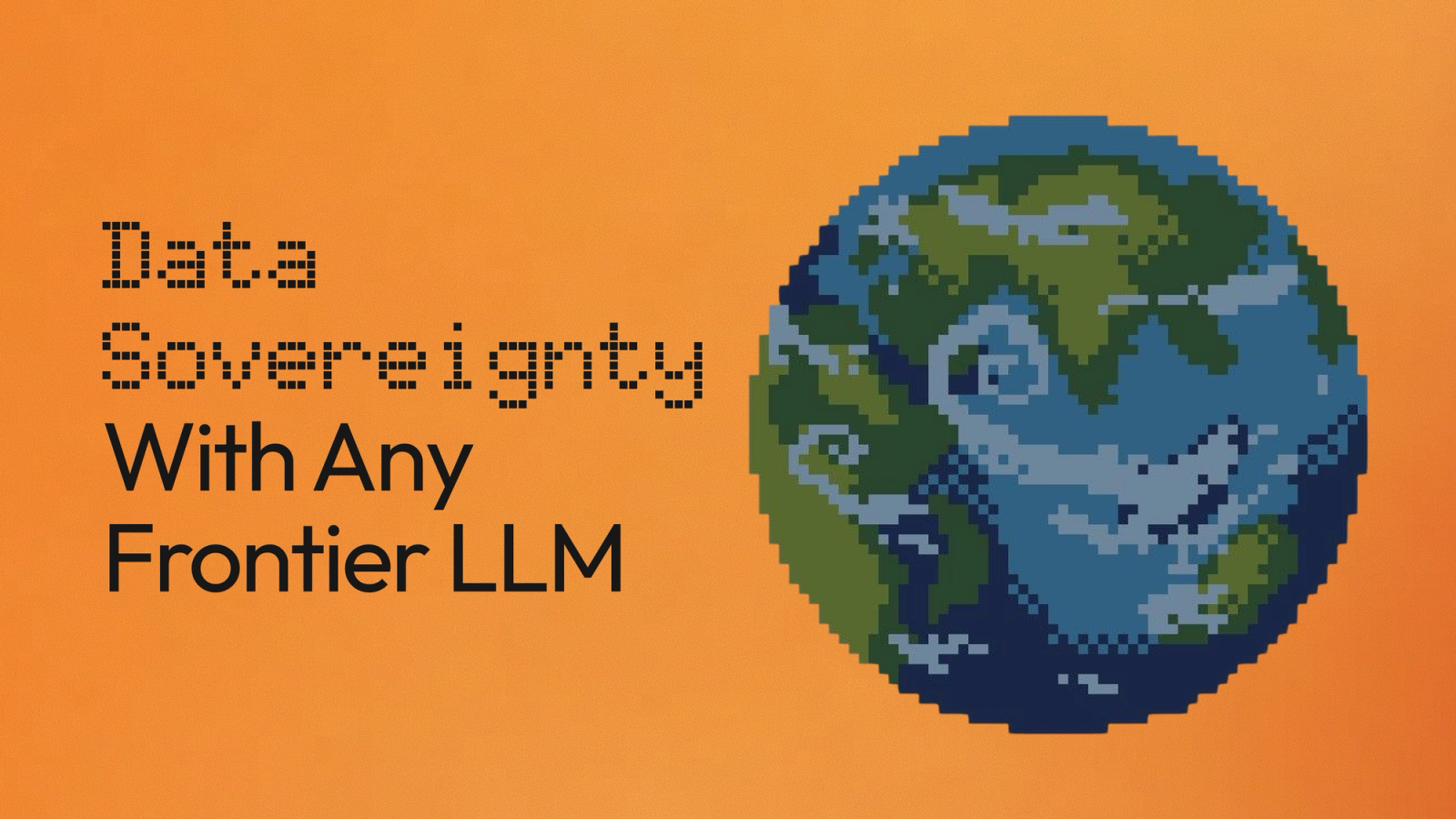
Every GCC enterprise adopting GenAI runs into the same tension. The best models run outside the region, but personal and sensitive data must stay within regional boundaries and under the enterprise's control. That leaves enterprises with a dilemma: use the latest frontier models, or keep their data secure. Most choose the second and go without the frontier models. The Mavs AI runtime control layer removes that trade-off by giving the enterprise full control of its data: which data is allowed to leave the region, which model it may go to, and a record of every interaction. Real data stays inside the residency border; the model receives a synthetic stand-in it can reason over, and the user reads the answer with the real values restored. Mavs runtime prompt security is what makes data sovereignty for enterprise AI in the GCC possible, without masking and without giving up the frontier models.
Data sovereignty is more than data residency
The two terms are often used as if they mean the same thing. It is worth separating them, because each one answers a different question.
- Data residency is about location. It means the data is stored on a server inside the country, in Dubai or Riyadh rather than in Virginia or Dublin, and it answers only the question "where is the data stored?"
- Data sovereignty is about control, at every stage. It answers the question "who processes the data, where, who can reach it, and can you still see it, correct it and erase it once it has left your systems?" In the GCC the answer has to satisfy your regulator, who expects the data to stay in the country and under your control for as long as it exists, not only while it is stored.
For GenAI the gap between the two is wider than for storage, because a prompt is not stored data. It is data in motion, assembled from CRM, mail and documents into one request, and it leaves a trail. The prompt goes to the model for inference, which may run in a region you did not choose. The conversation history is stored on the provider's servers. The provider keeps its own logs. Each of those is a place your data now lives, outside your control and often outside your knowledge. Keeping your own databases in-country does nothing about any of them.
What the GCC regulations require and the compliance gap in GenAI
The rules are already in force, and they treat processing as seriously as storage.
- Saudi Arabia. The PDPL has been in force since September 2023, with the grace period ended in September 2024. It limits processing to the purpose the data was collected for and gives individuals the right to access, correct and destroy their data. Both are difficult to demonstrate once a customer record has been submitted to a third-party AI service: the provider's retention and model-improvement terms govern what happens to it from that point, and the enterprise has no direct means of executing a destruction request against the provider's copy. The Regulation on Personal Data Transfer Outside the Kingdom, updated in September 2024, allows transfer only to jurisdictions SDAIA judges adequate, or under safeguards such as Standard Contractual Clauses or Binding Common Rules, and requires a risk assessment before the transfer.
- UAE. Federal Decree-Law No. 45 of 2021 carries the same purpose limitation and the same rights of access, rectification and erasure, and restricts cross-border transfer to adequate jurisdictions or transfers backed by contractual protection or consent (Articles 22 and 23). The Executive Regulations were still unpublished as of early 2026, so the base law is the operative text. Sector rules go further: Federal Law No. 2 of 2019 prohibits storing or processing health data outside the UAE, and Central Bank consumer protection standards require customer and transaction data to stay in-country.
Under either law, a prompt containing a customer's Emirates ID, a patient's record or a bank transaction, sent to a model hosted abroad, is a cross-border transfer on top of everything above. With chat assistants in everyday use, the likelihood of such a prompt being sent, and the difficulty of knowing when it has been, are both worth taking seriously.
Where the usual fixes fall short
- Block the tools. Endpoint DLP can stop ChatGPT at the network edge, and it does. Then people use personal phones, and the enterprise loses visibility along with the productivity.
- Redact before sending. Placeholders protect the data and break the model.
[NAME_1]owes[AMOUNT_2]due on[DATE_3]cannot be reconciled, compared or summed. The answer reads fine; the reasoning behind it was done blind. - Wait for a sovereign model. In-region model hosting is arriving in the GCC, and it is a real option for some workloads. It is also a bet on a smaller set of models, at higher cost, and it still leaves the provider inside your data path.
How Mavs AI enables data sovereignty for enterprise AI
Mavs is a runtime control layer that sits between your people, apps and agents and any LLM. It puts AI guardrails on every prompt at runtime: sensitive data is swapped for synthetic stand-ins, and prompt injection or jailbreak attempts are stopped, before anything reaches the model. The Mavs risk engine and audit logs run in a private tenant hosted in the region you choose. The only thing that leaves your region is a synthetic version of the prompt. The model answers using those synthetic values, and Mavs swaps the real ones back in after the answer has arrived.
Take a support agent in Abu Dhabi who types: Draft an email to Sarah Kohli, card 4519 8801, statement attached.
The model drafts a perfectly good email to Dani Singh about card 6011 2287. Mavs maps the values back before the agent sees it. She reads an email addressed to Sarah Kohli, with the right card number, and never saw a placeholder. The stand-ins are similarity-preserving, so a date stays a date and an amount stays an amount, and the model can reason correctly without ever having the real values.
Because the model never held the real value, there is nothing for it to leak, retain or train on. Every replacement is written to an immutable audit log in your tenant, which is the evidence a DPO produces when SDAIA or the UAE Data Office asks how the transfer was controlled.
The same protection covers more than personal data. It extends to business-sensitive data, the information that would hurt the business most if it left: deal codenames, unannounced pricing, M&A terms, key account lists, unreleased roadmap. None of it is PII, so pattern-matching tools do not see it. Mavs does, and substitutes it the same way (read how business-sensitive data detection works). A sovereign wealth fund can have a frontier model summarise a term sheet, or an energy company can have it review a bid, and the counterparty names and figures never leave the country. Using the best models on your most confidential work, without exposing it, is the part of this most enterprises have not yet realised is possible.
This works across the models your teams already want, including OpenAI, Claude and Gemini, and across every Mavs surface: Mavs Secure Chat, Claude Desktop secured by Mavs, and the API for agentic apps.
Ride on the frontier, keep the data home
Data sovereignty and frontier AI do not have to be a choice. The Mavs AI runtime control layer puts AI guardrails on every prompt, so your teams get OpenAI, Claude or Gemini, your DPO gets an audit trail, and your customers' data stays home.
If you are working through data sovereignty for enterprise AI in the UAE, Saudi Arabia or elsewhere in the GCC, book a demo and we will show you how it works.